
Sea Dragons and Floating Mountains
the mythology of Luofushan

Mythology is often coded to represent how ancient people saw the world. To understand the mythology, we first have to decode it.
Here, we look at the mythology surrounding the flora-rich tropical mountain Luofushan and the science that demystifies ancient tales.
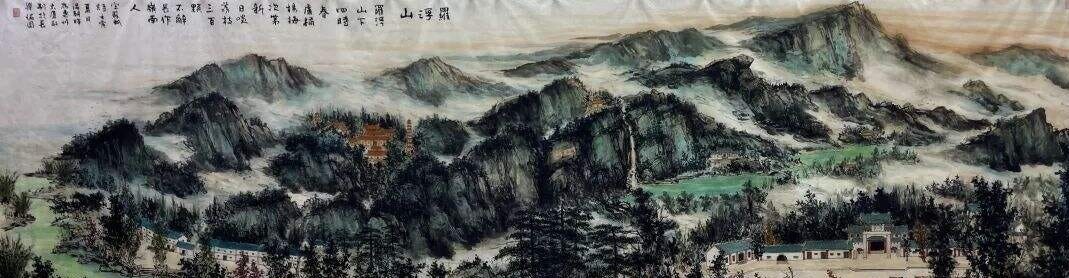
Luofushan, myth says, used to be two mountains, Lou 羅 And Fu浮. Lou Mountain, the ‘net’ mountain, was stationary, and connected by myth to the northeastern island of Penglai, when another mountain , Fu 浮’, floated’ in. The myth stems from ancient times, when a people called the Li lived in the southern Guangdong area. In a coastal society, where typhoons raged and monsoon winds tore along the lands, the tides and the winds combined with underground shaking to cause parts of the earth to sink and others to flood.
These people were once described as ‘sea dragons incarnate’. So well did they know the waves and the currents, and they believed Luofushan was an anchor mountain, fixing the land of Guangdong so that it would not be taken by the sea.
from Into the Mountains, Exploring China’s Sacred Daoist PeaksBeneath the old tales, lie storm science, tectonics and etymology, all submerged into coded mythology.
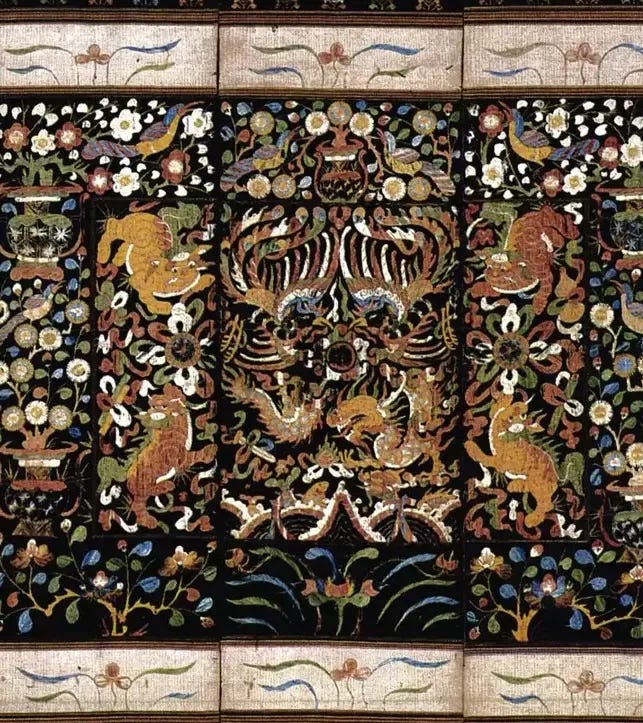
The Li people of Hainan - the “sea dragons incarnate” - were expert weavers, with embroidered dragons appearing on their bedding. They inked dragon tatoos on their legs, arms, and bodies. Their long bei 龙被, dragon quilts, were used for ceremonial purposes.
Their stories of Luofushan echo the discoveries of modern sciences like paleobotany, paleotempestology (the study of ancient tropical cyclones), geodynamics and geochronology.
The names of these sciences hint at their specialisation. 1
Monsoonal tides give us clues as to the origin of the story of Floating Net mountain. The waves were high in the South China Sea, and the winds brought sediment far inland. Tectonics, monsoons, rocks and storms wove together and changed land formations. Sandstone, easily eroded, built up coastal areas. Storm surges, rather than tsunamis, wreaked havoc with the land.
Paleobotanical studies suggest Hainan island was once connected to the mainland, and sometime in the Holocene era rising sea-levels flooded low-lying land and caused Hainan area to seperate.2
Two trees common to both Luofushan and Hainan are the Wood Lotus and lychee plant: they evidence the prehistoric connection of the island to the mainland.
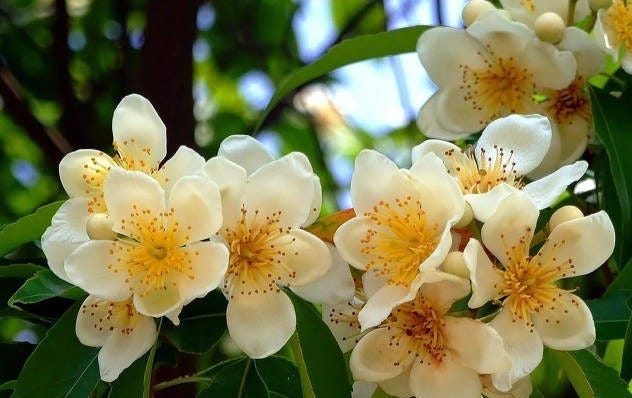
Muhe 木荷, or “wood lotus” is a type of jasmine, which grows profusely both in Luofushan and Hainan Island. It blooms in early summer and is known as the “Guardian of the Forests”.
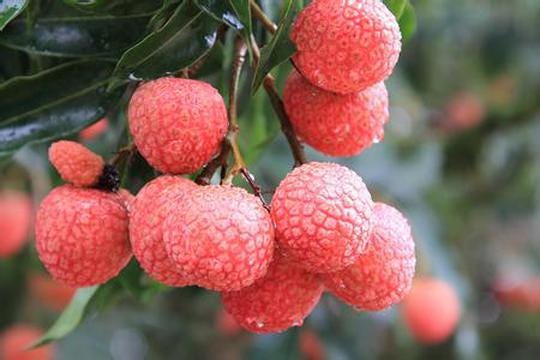
The lychees from Hainan are known for their sweetness and large size; Song poet Su Dongpo (Su Shi) favoured them. Exiled, he enjoyed the tropical climate:
食荔支二首并引·其二      Eating Lychees Second Poem
     苏轼                     Su Shi

罗浮山下四时春         At Luofushan it's spring all year round
卢橘杨梅次第新         loquats and bayberries ripen in turn
日啖荔枝三百颗         eating three hundred lychees a day
不辞长作岭南人        i wouldn't mind being a Lingnan person forever
A Song dynasty poet explained the naming of the mountain:
During the time of Emperor Yao, the great flood stopped striking at Mount Luo, so the mountains gained the name “Luofu”.3
The character itself symbolizes surrounding water, and many Chinese mountains with fu 浮 in their name stem from the time of Emperors Yao, Shun and Yu the Great.4
Myths of ancient floods surged through the centuries, recorded in local chronicles and dynastic histories.
Poets came, and had their say.
Xie Lingyun was the first, Su Shi visited and wrote many poems, Li Bai wanted to visit but wasn’t able to - that did not stop him from writing a poem about the mountain. Li He, the poet of ghosts, Lu You, the writer of travel journeys, both wrote Luofushan poems and Du Fu wrote a couple of lines. 5
Bao Gu, the acupuncturist, and Ge Hong, the alchemist lived there.
Bao Gu gathered herbs on the mountain, developed moxibustion techniques, and treated locals with acupuncture.
Ge Hong was the nephew of the Tea Ancestor, Ge Xuan, a Daoist who also had potentially visited Luofushan earlier. The Ge family was highly involved with the Daoist Lingbo tradtion.

Ge Hong is famed as an alchemist who washed minerals for making elixirs in the pools on the mountain and wrote a treatise called the Baopuzi.6 Temples dedicated to Bao Gu and Ge Hong are still thriving on Luofushan.
This famous family moving to this sacred mountain has become the subject of many paintings across the centuries.

an emperor had a dream about luofushan
Liu Yan 刘岩, a ninth century emperor of the Southern Han during the Five Dynasties period, ordered a large-scale construction project in Jinsha Cave, on Floating Net Mountain. When the Tianhua Gong was finished, the emperor came to inspect it. that night he had a dream, that a yellow dragon flew above the temple, so he renamed the cave Yellow Dragon (Huang Long 黄龙.) Much later during the Qing dynasty, a Laoshan Daoist visited the cave and built a temple there, naming it the Yellow Dragon Ancient Temple (Huang Long 黄龙古观)after the emperor’s dream.
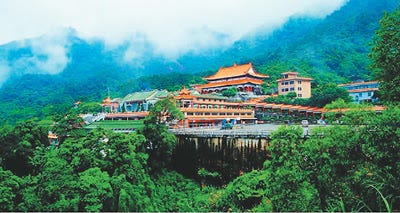
and in the twentieth Century, Hao Baoyuan came, built a temple, and stayed.
Like many places in China, the temple was destroyed during the Cultural Revolution. During the 1990s, Qingsong Guan 青松观 Abbot Hou Baoyuan 候宝垣 oversaw the construction of a new Yellow Dragon Temple. Consecrated in 1995 and officially opened in in 1997, Abbot Hou lived there until his ascension in 1999.
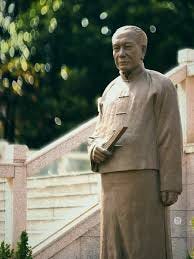
Abbot Hou’s vision was grand - the Yellow Dragon Ancient Temple covers almost 1,000 square metres and sits peacefully amidst the clouds, looking out over the valley below. Altar halls are built into the slope, rising above each other beside aqueducts where spring water trickles downward.
eventually, i came too.
A tropical forest hugged the mountain with trees that glistened like Burmese emeralds. We drove through an enormous three-tiered archway that covered the road, and was inscribed with the words 黄龙古宫 Huang Long Gu Guan, the Yellow Dragon Ancient Temple. Eventually we turned a corner and came to an abrupt stop in a vast courtyard.
The view was breathtaking. A vast complex spread out in front of me. A ladder of pavilion-covered stairs reached up to a large two-story hall, resting among the green mountains. Large vermillion pillars supported the tiled roof. Other smaller buildings framed the right side of the square. Turning to look behind me, the road snaked down the mountain. The air was fresh and cool, the village below far away, belonging to another world.
Abbot Hou was busy pruning his beloved bonsai. Later, he invited me to join the students studying chanting.
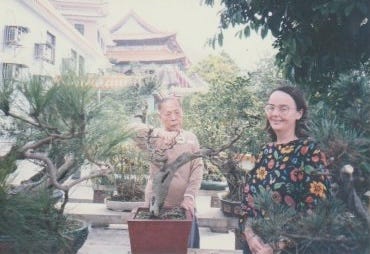
Read more about Luofushan, and other extraordinary Daoist peaks, in my book.

Into the Mountains is available at my publisher https://earnshawbooks.com/product/into-the-mountains/
Barnes and Noble
https://www.barnesandnoble.com/w/into-the-mountains-debra-liu/1147763934
Amazon
https://www.amazon.com/dp/B0F52YHFXD
Order now to get your copy in time for Christmas!
Bibliography
Chai, Mengyuan. 2022. Idealizing a Daoist Grotto-Heaven:The Luofu Mountains in LuofuYesheng羅浮野乘. Religions 13: 1043. https://doi.org/10.3390/rel
Chinalai, LJ, and Chinalai, Vichai, 2003. Ceremonial Dragon Covers of the Li of Hainan, Hali, , Carpet Textile and Islamic Art, issue 130, Sept-Oct 2003.https://reader.exacteditions.com/issues/47424/page/58
Lin, C. (2023) The Evolution of Landscape Layout Concept of Lingnan Taoist Zuting Temples in the Qing Dynasty. Natural Resources, 14, 121-133. doi: 10.4236/nr.2023.148009.
Schafer, Edward, 1970. Shore of Pearls, Hainan Island in Early Times, University of California Press, Berkeley.
Yu, Ke Fu, Zhao, Jian Xin, Shi, Qi, and Meng, Qing-Shan (2009). Reconstruction of storm/tsunami records over the last 4000 years using transported coral blocks and lagoon deposits in the southern South China Sea. Quaternary International 195 (1-2) 128-137. https://doi.org/10.1016/j.quaint.2008.05.004
Zhang, Jiayang & Chen, Yangbo. 2019. “Risk Assessment of Flood Disaster Induced by Typhoon Rainstorms in Guangdong Province, China,” Sustainability, MDPI, vol. 11(10), pages 1-20, May.
Notes
All text in italics are direct quotes from the book.
The first photograph is of a painting Luofu Mountain, by Wen Zhaohui. Wen Zhaohui is a modern artist and cultural administrator who has been active in Guangdong artist associations, tertiary education, and media promotion. He is a Specially Appointed Painter of the Guangzhou Academy of Painting
The names of these sciences hint at their specialisation. Paleobotany is the history of plants throughout geological time, paleotempestology is the study of ancient tropical cyclones, geodynamics is a subfield of geophysics which studies the dynamic processes which form the earth, and geochronology dates deep time, by identifying mineral signatures inside rocks and fossils.
Excerpt from Into the Mountains, Exploring China’s Sacred Daoist Peaks. Yu et al (2009) show how weather patterns, storms and tsunamis contributed to the formation of the Cantonese mainland.
This is a quote from Into the Mountains. The poet was Chen Yaozuo, an early Song dynasty official who was famous for water conservancy projects, including a plan to stem the Qiantang tidal bore near Hangzhou by closing a breach in the Yellow River and building dikes upriver. His poem Luofu tuzan”羅浮圖贊 is cited by Chai, 2022.
The word fu 浮 in the mountains name is usually interpreted as “floating”, yet historically the word was used in naming mountains that, viewed from a distance, appeared to float as they were surrounded by water, often at high tide. The character has the water radical on the left, and the right radical originally had the sense of ‘to envelop’ or to ‘enclose’, giving the sense of surrounding water.
For more on Du Fu, see
https://debraliu.substack.com/p/du-fu
, for Li Bai’s rare occasion being rendered speechless see,
https://debraliu.substack.com/p/spectacular
Yuxuan Francis Liu has a biography of Xie Lingyun
https://substack.com/home/post/p-180955491
Louis Komjathy and the Daoist Translation Committee have just published a new, and first complete annotated English translation of the Bǎopǔzǐ nèipiān 抱朴子內篇 at Square Inch Press. https://www.daoistfoundation.org/imprint.
Loved the science, the Su, the litchi, and the bonsai! Debbie, this is has everything. 🌹
Another great article -- thank you! I especially appreciate how you weave the interesting culture and history together and incorporate the Chinese words.