
The Flower that Emperors stole

A flower so beautiful it was compared to white jade, grew in the temple to the Goddess of the Earth.
Breathing the evening mist oh! Eat the morning sunrise glow!
Chewing the fungus of longevity, but oh! the white jade flower
This was only the first of many poems to exalt the flower’s beauty. Sima Xiangru, one of China’s best rhapsody (fu 賦) poets, wrote these lines when he had been appointed as director of the Xiaowen Gardens during the reign of Han emperor Wu.
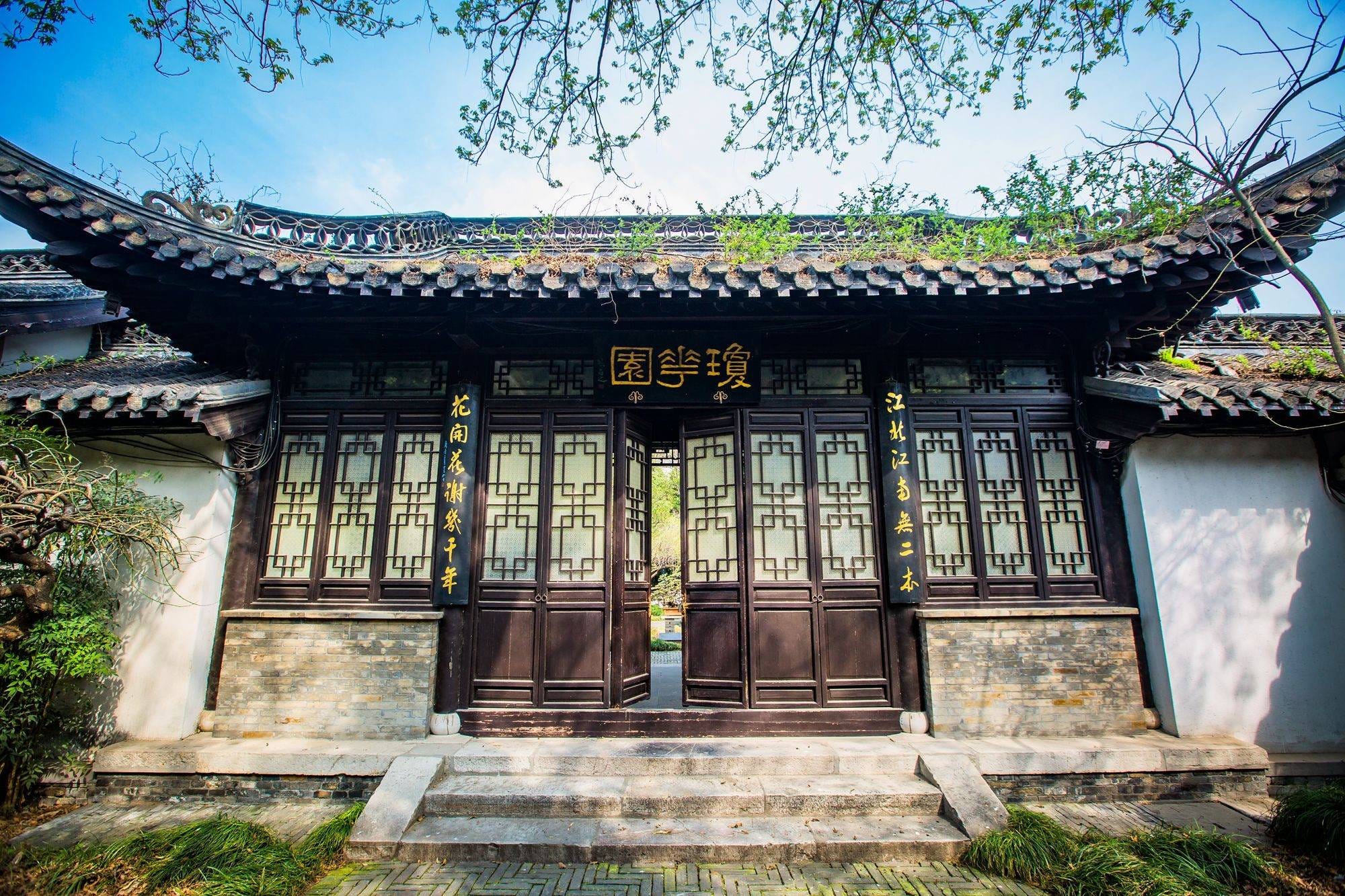
The Houtu Temple (Houtu 后图 was the Goddess of the Earth) in Yangzhou, a city of waterways and gardens sitting at the confluence of the Yangtze River, dates back to the 11th Century BCE, the time of the young Han emperor Chang. Houtu, as the Earth Goddess, governed the cycle of nature, nurturing all living things.
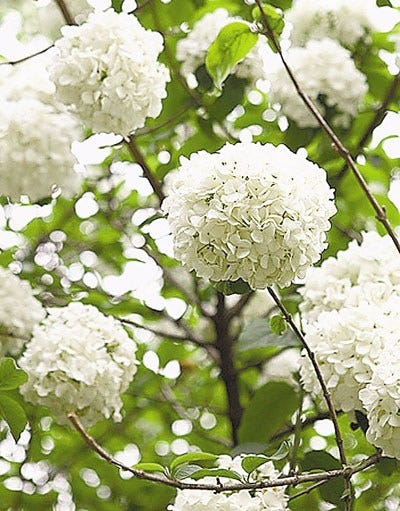
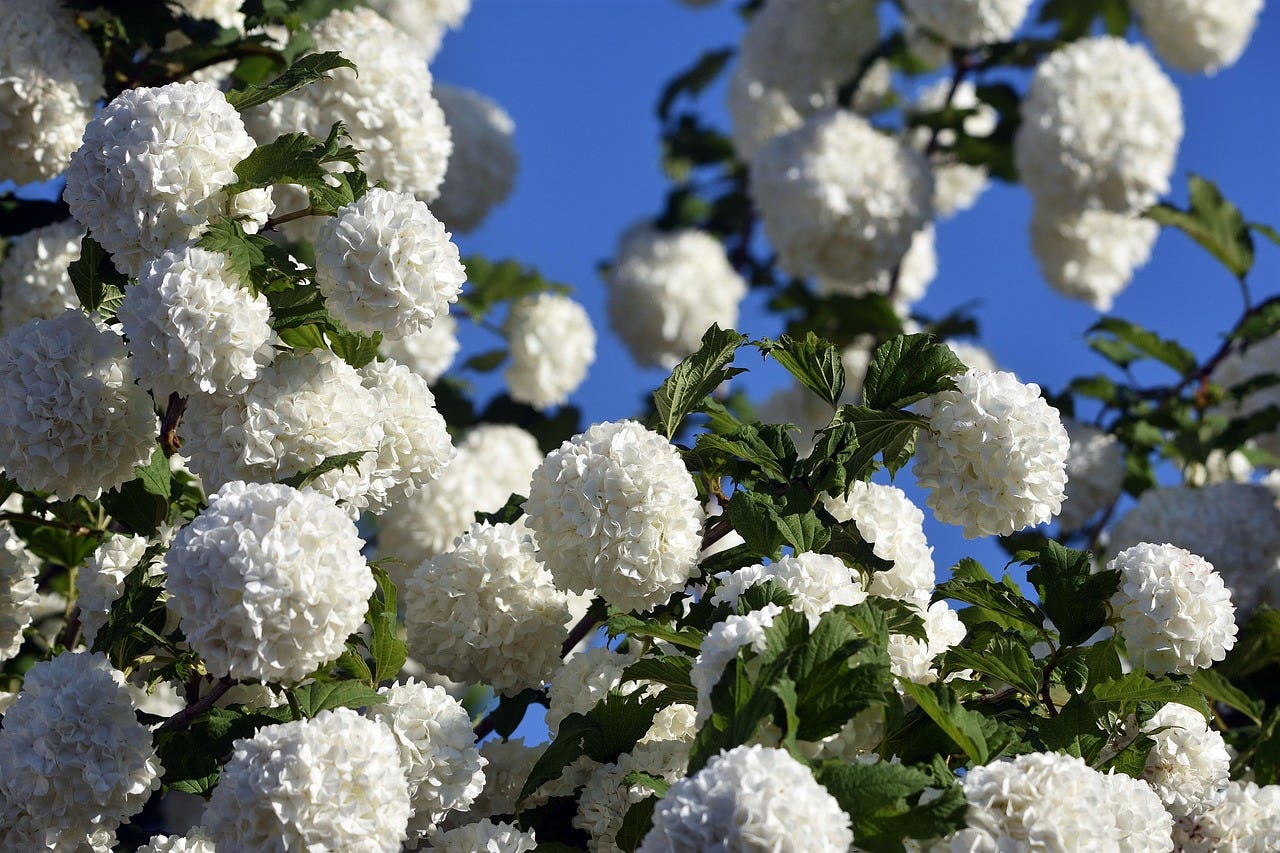
A magnificent flower, the silky white petals of viburnum appeared to be as fine as white jade, giving the flower it’s name: qiong 琼. A flowering bush, covered with medallions of glistening white, appeared in the Houtu shrine. Beloved by poets , emperors and common folk who came to witness its glory, the white jade flower eventually gave its name to the temple.
Ming novels claim the Sui emperor wanted to see its blossoming wonder, and travelled to Yangzhou for that reason, but the first historical record dates to the Song; mainly in the words of poets.
百花天下多,琼花天上稀, gushed Xianyu Shen, a transport commissioner and classical scholar, who was credited with first spying, then writing about, the lovely blossoms in the ancient temple. White flowers abound in the world, but the white jade flowers are rare in heaven.
Ouyang Xiu, prefect of Yangzhou and famous Song poet was so enamoured of the flower he built a pavilion around it, from where to relax and admire its beauty. qionghua and peonies are unparalled in the world, he wrote, if i dont write a poem about them people will complain.
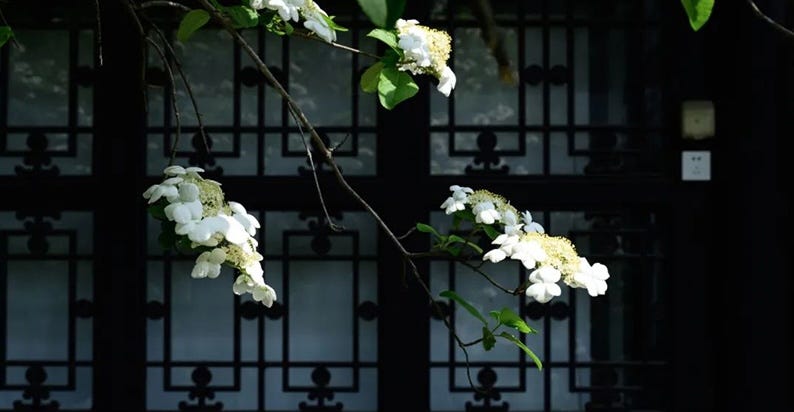
Han Qi, Prime Minister to three emperors of the Northern Song and two years a prefect of Yangzhou, loved the viburnum flower.
韩琦《琼花》

维扬一株花,四海无同类。
年年后土祠,独比琼瑶贵。
中含散水芳,外团蝴蝶戏。

In Yangzhou, one singular blossom, nothing quite like it in the entire world
blooming year after year in the Earth Goddess’s shrine, only comparable to precious jade
Watery fragrance is scattered inside, outside a group butterflies play
“Every butterfly is a ghost of a flower, returning to find itself”. Eileen Chang and Yan Ying.
After numerous official roles, Han Qi, known for his upright and compassionate nature (he provided food relief for famine victims and once impeached four high officials) became Prime Minister to Emperor Renzhong. Perhaps due to Han Qi’s extravagant poetic complements to the White Jade Flower, Renzhong decided he wanted it.
Emperors don’t exactly steal - they own everything under heaven. Rather, Renzhong ordered the flower to be removed from the temple and transported to Bianjing (Kaifeng), the capital. After a year, it withered and could not be coaxed to life. It was returned to the Earth Goddess’s Temple, were it sprouted and blossomed.
Thirty-seven years and three emperors later, the talented artist Huizong took over the imperial reins. Emperor Huizong bestowed a plaque, renaming the shrine as Fanli Guan 蕃釐观, Abundant and Prosperous Temple. Once again, the beautiful jade-like flower was ‘taken’, then transported to the capital; once again it sickened and had to be returned.
The Jurchen army was encroaching. Huizong fled south. A branch of the special tree was grafted and taken to Ling’an (Hangzhou, about to become the Southern Song capital); it survived, but with diminished fragrance and lacking in vibrancy.
Not long after the Jurchens captured Huizong and established the northern Jin dynasty. Now it was Digunai, or Wanyan Liang, emperor of the Jin, who coveted the qiong flower. He ordered the main stem dug up. A Daoist priest named Jin Daning 金大宁 managed to revive the plant from roots left in the soil. He prayed to Houtu, the Goddess of the Earth. Once again, the qiong hua 琼花 flourished.
Mysteriously, in 1279, the White Jade Flower suddenly withered. It was the same year that the Song dynasty finally collapsed.
Twenty years later, another Daoist, Jin Neirui 金内瑞, transplanted an Eight Immortals viburnum to the roots of the existing plant, eventually succeeding in cultivating it. The Eight Immortals vibunium bears fruit; it is the plant that Jin Neirui cultivated that is the ancestor of all White Jade flowers in Yangzhou today.
This plant not the same as the viburnum you may find in your local garden shop. The flower so beautiful that emperors coveted it is “viburnum macrocephalum” or “viburnum sinensis”.
The White Jade Flower plant that had mysteriously died after the collapse of the Song dynasty, coveted and “taken” by three emperors, has survived and flourished.
Poets waxed lyrical about it, emperors coveted it, and Daoists rescued it.
Qionghua plants are still found in the Qionghua Temple, Yangzhou. They are descendants of the hybrid plant that grew when an Eight Immortals variety was grafted to the dying roots of the original bush, grown in the Yangzhou temple for centuries.
What a beautiful surprise! The viburnum carlesii was the favourite flower of my mother. She took me strolling between the blossoming as a baby. I didn't know this variety. Thank you, Debbie, for another enchanting story🫶🫶 🫶
What a fascinating story! Do you happen to know the blooming month of the qonghua? I'm going to visit Nanjing in 3 weeks. If the timing is right, maybe I should visit Yangzhou too.