
everyone gets lost in laoshan
mountain of mystery and magnetism

Everyone gets lost in Laoshan.
If visitors don’t get lost, sometimes, there’s a trial by fire, an emotional reckoning,
Perhaps it’s the mist, perhaps its the wilderness. Perhaps its the hidden valleys and barely scalable cliffs. Most definitely it’s a consequence of stepping off the pathways and into the interior of the this granite mountain, one hundred million years old.
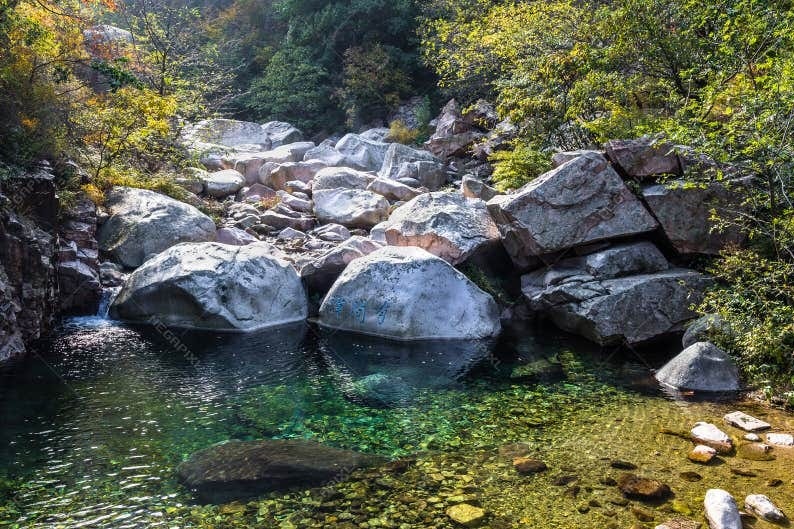
The serpentine paths and meandering rockpools along gorges that twist and turn, combined with coastal fog that suddenly appears, make the Beijiushui (Nine Waters) area dangerous for anyone going off the paths and walkways. Yet still people try. Maraton runners on the Laoshan 100, trying to take short cuts, have got lost. Deng Xiaoping sent the PLA there to train — experienced soldiers could not find their way in this mysterious mountain.
I knew of a man who decided to hike the hills of Laoshan. He became lost, had only one bottle of water, and roamed around the mountain in the heat of summer trying to find his way out. He came close to death but was rescued on the third day by other hikers. 1
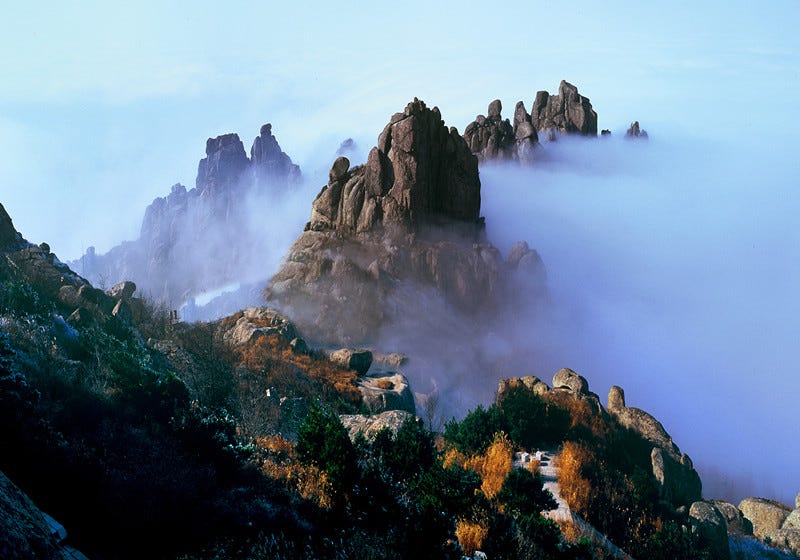
Getting lost on Laoshan has a long history. Tang dynasty general Xue Rengui,according to oral history, followed emperor Taizong on his eastern expedition. Taizong was planning to use the sea route from Laoshan to invade Korea. The general‘s troops were stunned by the beauty of Beijiushui, and lost their way. Rengui pushed his horse up the steep ridges and jagged cliffs, where the Thousand Layer Rock, caused by chaotic rises of an ancient seabed, protruded. Reaching the summit, he could now see the way down to the sea. His horse, exhausted, turned to stone, where it remains on top of a cliff near the sixth waterway of Nine Waters.
It’s not just Laoshan where people lose their way. People get lost in many other mountains across the world, usually in places that are rugged, wild, hard to access.
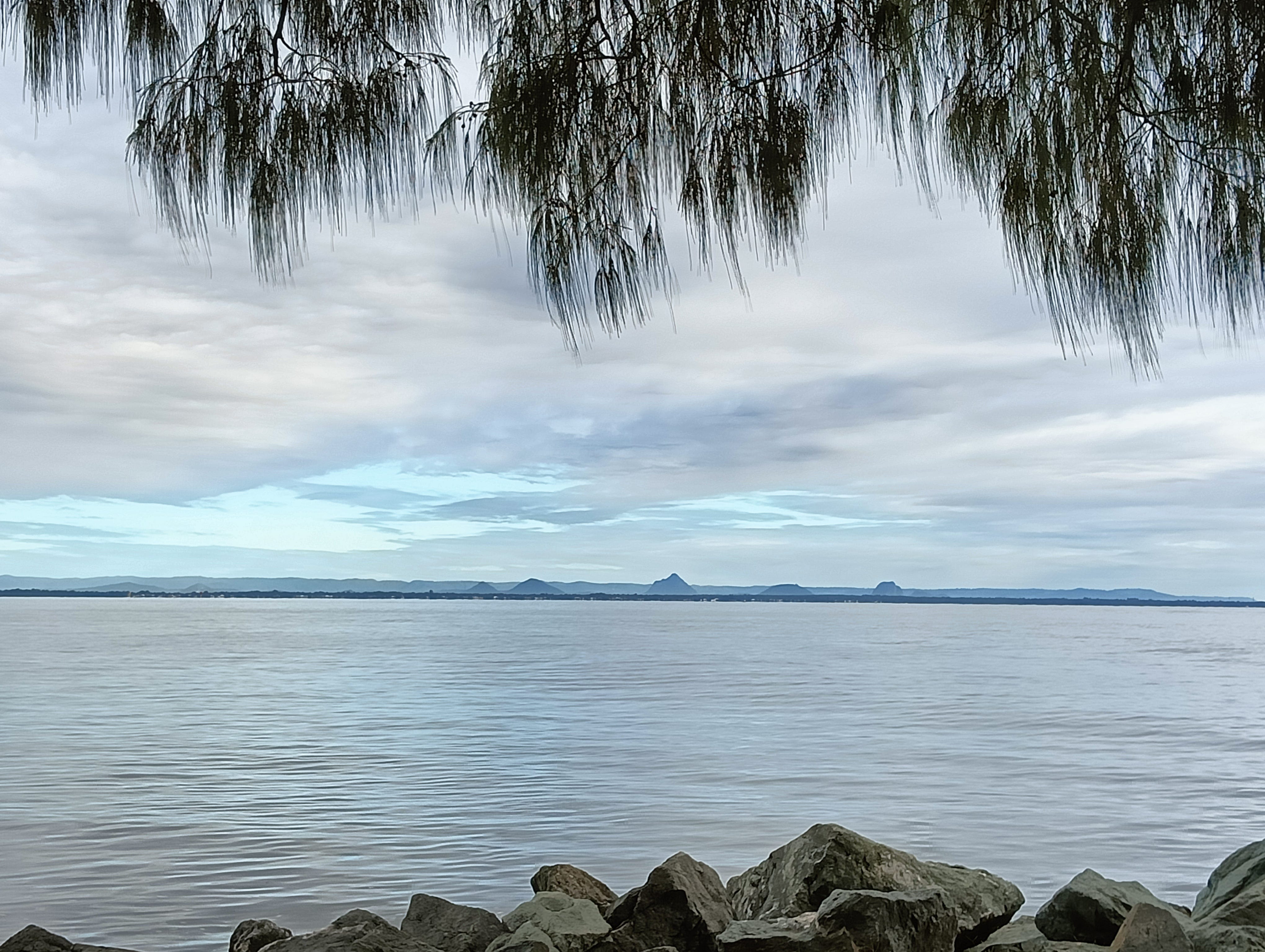
A group of mountains near where I live are sacred to the Jinbara nation. Thirteen volcanic peaks form a family of mountains, mother, father and children. Mt Beerwah, the mother mountain, is sacred to Jinbara people. Hikers like to go there, and often, get lost.
The Jinbara nation actively discourages climbers, but has no legal status to stop this practice, unlike Uluru, in Australia’s centre. Home to the Anangu people, Uluru is a sacred site and climbing was banned in 2019.
"It's the energy from the mountain and we're not supposed to climb it and people don't pay attention to that feeling,”2 said a Jinbara spokesperson.
Some scientists believe it is the particular geophysical formations of certain mountains which lead to changes in consciousness.
Fault lines, magnetic anomalies, the concentration of certain ores and magma, and geomagnetic storms which modulate the intensity of the geometric field, all contribute to magnetic fluctuations that can influence human experience.3
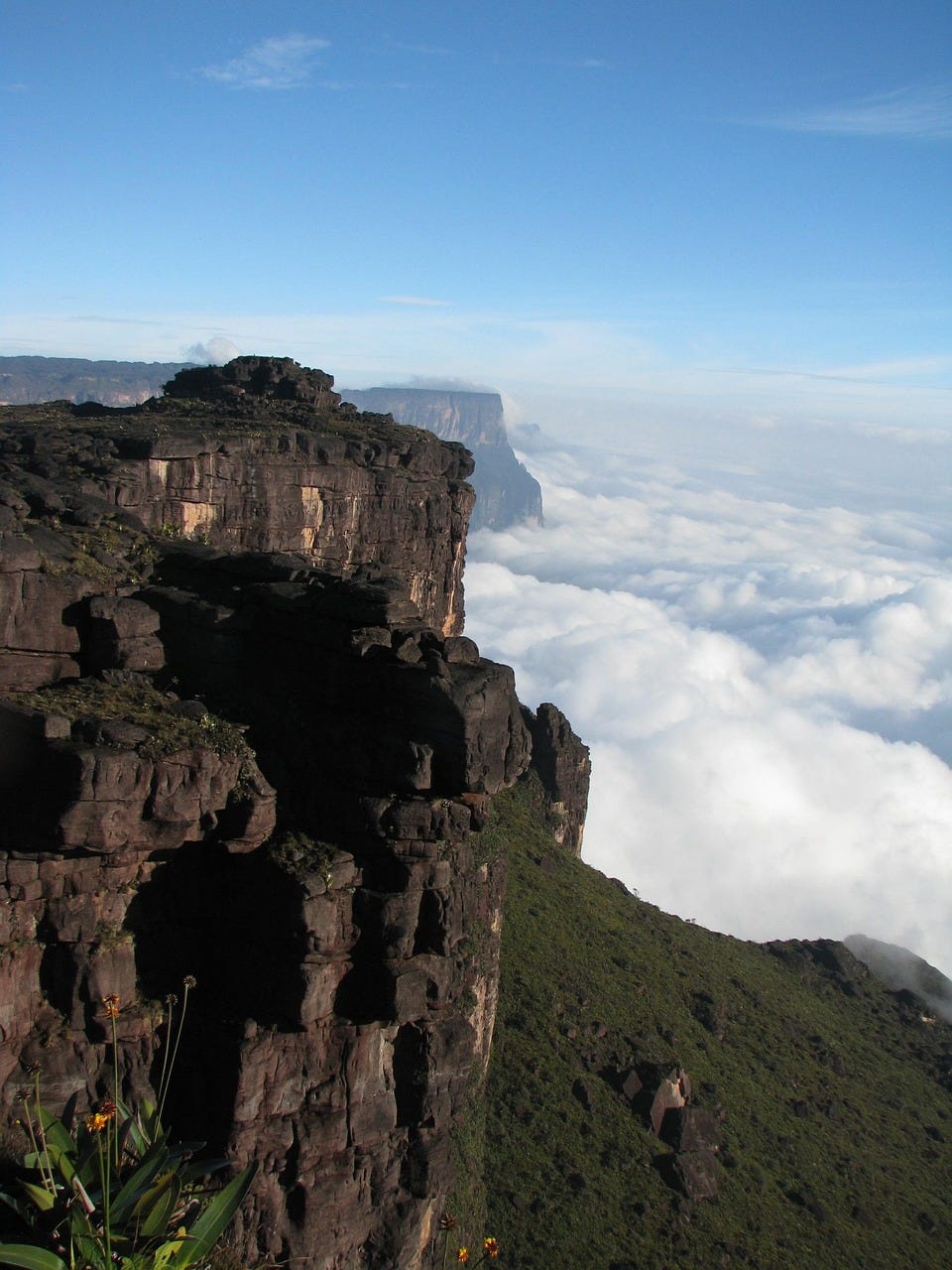
Mt Roraima, in Venezueala, is home to the Taurepan people, part of the wider Pemon. It is a tepui, or tabletop mountain, rich in quartz and iron. Compasses act erratically on the mountaintop; people are known to walk around in circles and go completely missing. Nowadays, it’s only possible to scale this wild place with the permission and help of the Taurepan,.
To the Pemon people, it is the home of the gods. Like Laoshan, waterfalls thunder down rocky cliffs, forming tiers of rushing water that create clouds of mist and fog.
To these people, Roraima — rorai meaning blue-green and ma meaning great — is the mother of everything, the giver of life .
Walking in silence on the mountain, and showing respect to each rock is sacred practice to the Taurepans. To disrespect the Great Blue-green is to lose your way, and sometimes, to lose your life.
Losing your way in Laoshan has an esteemed heritage. Way back in the Han dynasty, around the time when BCE became CE, a man by the name of Feng Meng was concerned about a change of dynastic rule. He left the court, and literally removed his hat and hung it on the eastern gate of the city, and headed to Laoshan.
Feng Meng spent his days studying Daoism on Laoshan. When he was recalled by the Emperor, he said, mi buzhi dongxi 迷不知東西, I’m confused and I don’t know east from west, and refused to go.
This has led to an idiom still used today —milu dongxi 迷路东西,or getting lost from east to west - that is to say, completely disorientated.
People are still getting lost on Laoshan.
One of China’s most renowned modern artists, Wu Guangzong, was also once lost in in this mysterious mountain and created 误入崂山 (wu ru lao shan), Mistakenly Entering Laoshan, in 1988. It is a coloured ink painting, and sold for 21 million RMB in 2010.4
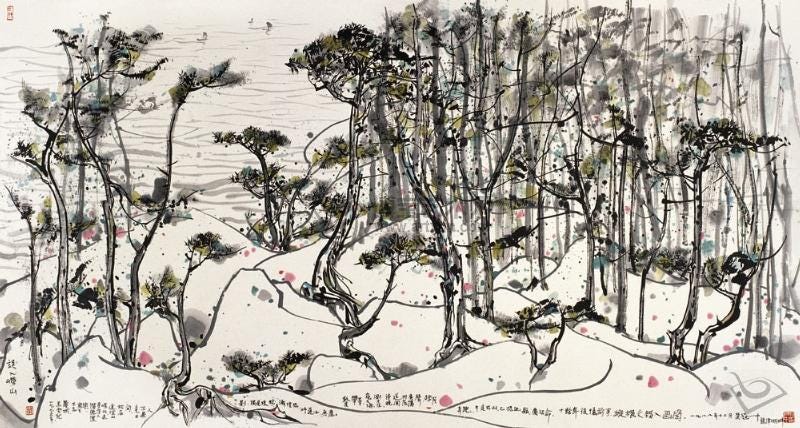
Mr Wu described his ordeal that led to the creation of this work:
“In the summer of 1975, I and some friends from Qingdao went to Laoshan to sketch. The scenery along the way was breathtaking: dense forests and strangely shaped rocks When thirsty, we could easily find Laoshan mineral springs. We walked and commented on the scenery and the composition of the photos, feeling completely carefree, as if we had entered a paradise.”
Mr Wu and his friends got lost.
We climbed several peaks, glimpsed the vast sea, and determined our location. At dusk, we heard a village broadcast, ran under the moonlight, and emerged from the mountains at midnight, having reached another county, thankful to have survived. More than ten years later, recalling this event, I incorporated it into the painting.5

Magnetic anomalies can cause disorientation and cause neurological changes. Is there any mineral in Laoshan that could cause such anomalies?
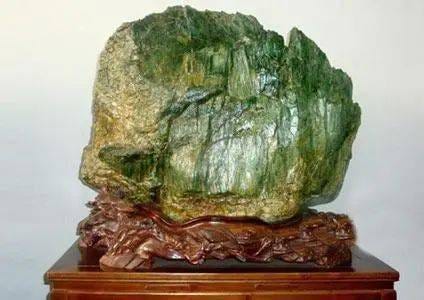
Serpentine Jade.
Laoshan Jade is a renowned deep green jade, used as a tribute crystal in the Qing and to make scholar’s stones for calligraphy. Laoshan sits on a bedrock of iron and magnesium rich mantle, which at certain temperatures and hydration levels can cause serpentization. Laoshan, as it turns out, particularly near Yangkou, is rich in magnetite.
Magnetite is product of serpentization, known to cause magnetic anomalies.
Changes
Laoshan worked it’s mysterious ways in a manner which was to have profound effect on the world.
Famous translator of the Book of Changes, Richard Wilhelm, was living in Qingdao and visited Laoshan. He was visiting his friend, a Daoist priest, and stayed the night. There he had a dream.
A kind old man with a long beard visited him, and introduced himself simply as “Laoshan”. After he woke from the mysterious dream, still in Laoshan, Wilhelm decided to translate the Book of Changes.6
Perhaps the Yi Jing 易经 (I Ching) would never have been translated if not for a dream on Laoshan.
Bibliography
Arzy, S., Idel, M., Landis, T., & Blanke, O. (2005). Why revelations have occurred on mountains? Linking mystical experiences and cognitive neuroscience. Medical Hypotheses, 65(5), 841–845. doi.org
Kopylov, I. P. "Sacred Places and Geophysical Activity." Man and the Geosphere, edited by Igor V. Florinsky, Nova Science Publishers, 2010, pp. 215–255
Google Arts and Culutre, Mount Roraima, The ancient world of South America tepuis.
Maffione, M., A.Morris, O.Plümper, and D. J. J.vanHinsbergen (2014), Magnetic properties of variably serpentinized peridotites and their implication for the evolution of oceanic core complexes, Geochem. Geophys. Geosyst., 15, 923–944, doi:10.1002/2013GC004993.
Wilhelm, Richard. The Soul of China. Translated by John Holroyd-Reece, Harcourt, Brace and Company, 1928.
Wu, Guanzhong: A Surprising Journey to Laoshan by Accident, 2017, Qingdao Tourist Bureau. https://www.sohu.com/a/212635327_349483
Zagorski, Marcus. 2023. “The Sacred Soundscapes of Mountain Wilderness” Religions 14, no. 8: 992. https://doi.org/10.3390/rel14080992
I wrote about him in Into the Mountains, Exploring China’s Sacred Daoist Peaks. He was a colleague, and took some time to recover from the ordeal.
BJ Murphy, traditional custodian of Mt Beerwah and surrounding lands, was quoted in an ABC news article. Mr Murhpy, his mother, and other members of the Jinbara Nation often sit at the bottom of the mountain, asking people not to climb the sacred site.
Arzy et al, 2005, Kopylov, 2010, and Maffione, 2024.
Mr Wu has a number of paintings listed at Christies. The sale record for his paintings at Christies was the equivalent of $US 30 million. Wu is seen as the founder of Chinese modern painting. He left the world, aged 90, in 2010.
Wu, 2017.
Wilhelm told this story in his book The Soul of China.
That was great, Debbie, thank you. 🙏🏻 The artwork and the jade! Tremendous.
go Debbie :) xx